If you’ve ever watched a chef flip shrimp through the air, send flames erupting from an onion volcano, and crack an egg with a single spinning spatula flick, you already understand why Hibachi Japanese dining is one of America’s most beloved culinary experiences.
But what exactly is Hibachi Japanese? Where did it come from? How does it differ from teppanyaki? And why does dining at a Hibachi Japanese steakhouse feel less like a restaurant visit and more like a shared event?
This complete guide answers every question, from the ancient origins of hibachi in Japan to the knife techniques, flame mastery, and tableside performance that define the experience today. Whether you’re a first-time visitor or a longtime fan, this is your definitive resource for understanding Hibachi Japanese dining.
Key Takeaways:
- Hibachi Japanese dining combines centuries-old Japanese culinary tradition with live, tableside performance cooking, making it as much an event as a meal
- The terms “hibachi” and “teppanyaki” are often used interchangeably in the U.S., but they are technically distinct cooking styles. Most American hibachi restaurants use teppanyaki-style flat iron griddles
- A Hibachi Japanese meal typically includes soup, salad, hibachi fried rice, fresh vegetables, and your choice of premium protein, all cooked in front of you by a trained chef
- The communal grill table format makes Hibachi Japanese dining the top choice for birthdays, date nights, family celebrations, and corporate dinners
What Is Hibachi Japanese? A Complete Definition
The term Hibachi Japanese gets used broadly in the United States, but its origins are more specific and more interesting than most diners realize.
In its original form, a hibachi (火鉢) was a small, portable charcoal heating vessel used in Japanese homes during the Heian period (794–1185 AD). The word itself translates directly to “fire bowl.” It was designed to warm rooms, not cook food. Over centuries, the functional simplicity of the hibachi evolved into a cooking method, using direct charcoal heat to grill meats and vegetables with clean, bold flavor.
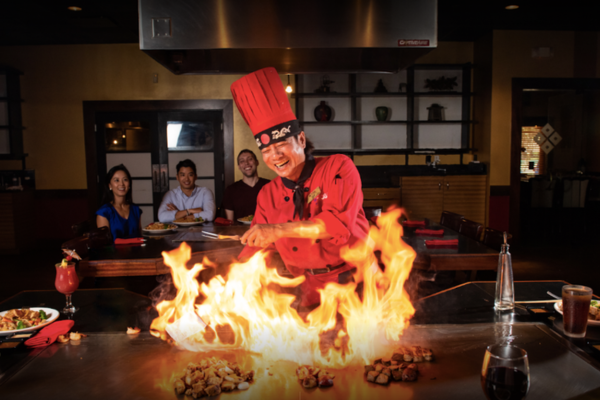
In modern American usage, Hibachi Japanese dining refers to a specific restaurant experience: skilled chefs cooking on a large, flat iron griddle (technically a teppan) directly in front of a communal table of guests, combining premium ingredients with high-energy theatrical performance.
Today, when someone searches for Hibachi Japanese dining, they’re seeking a meal that is simultaneously a show, a social event, and a culinary experience unlike anything else.
Hibachi Japanese vs. Teppanyaki: The Real Difference
The distinction between hibachi and teppanyaki is one of the most commonly searched questions in this culinary space, and it matters.
Traditional Hibachi
- Uses a small, open charcoal or gas grill
- Often associated with intimate, direct-flame grilling
- Guests may cook their own food at the grill
- Emphasizes heat control, smoke, and sear
Teppanyaki
This is what most U.S. hibachi restaurants actually serve.
- Uses a large, flat iron griddle (teppan) heated by gas
- Multiple diners are seated around a shared cooking surface
- Chef performs cooking live for the table
- Knife tricks, flame displays, and egg rolls are signature techniques
Here’s the critical insight: most American restaurants that market themselves as “Hibachi Japanese” restaurants are technically serving teppanyaki-style cooking. Over decades of American dining culture, the word hibachi became the dominant consumer term, and it stuck. The experience is the teppanyaki technique under the hibachi name.
The result is a dining style that is uniquely American in its presentation while remaining authentically Japanese in its culinary roots.
If you’d like a deeper comparison, explore this full breakdown:
The History of Hibachi Japanese: From Ancient Japan to American Tables
Understanding the history of Hibachi Japanese dining gives context to why the experience feels so distinct from standard restaurant dining.
Origins in Japan: The Heian Period (794–1185 AD)
The earliest hibachi devices were crafted from clay, ceramic, or wood lined with metal, and were used purely for warmth. Wealthy Japanese households kept elaborately decorated hibachi in their homes as both functional heating tools and status symbols. Early forms were found as far back as the Heian Court in Kyoto.
Over time, particularly among common people and street vendors, the open flame of the hibachi transitioned into a cooking implement, a way to char fish, vegetables, and meats with the simplicity of direct heat.
The 20th Century: Teppanyaki Goes Global
The dining experience was commercialized in 1945 when Misono, based in Kobe, Japan, opened its doors. Shigeji Fujioka, one of the chefs at Misono, is said to be the originator of the modern style of teppanyaki. Fujioka’s innovation was positioning the iron griddle as theater: diners would sit around the flat cooking surface and watch chefs prepare their meals in real time.
The concept spread rapidly. Japanese chefs introduced the format to American diners in the post-World War II era, where the combination of live cooking, communal seating, and precision knife work captivated audiences who had never experienced anything like it.
By the late 20th century, Hibachi Japanese steakhouses had become fixtures across American cities, beloved for the interactive, celebratory atmosphere they created.
Hibachi Japanese in Florida: The Modern Era
Florida’s diverse, tourism-driven dining culture made it a natural home for Hibachi Japanese steakhouses. With millions of domestic and international visitors annually, particularly concentrated in the Orlando metro area, the demand for experiential dining experiences is perennially high.
Kobé Japanese Steakhouse emerged from this landscape to become one of Florida’s most recognized Hibachi Japanese dining brands, with multiple locations across the state and a reputation built on consistent quality, chef performance, and hospitality.
For a more in-depth look at its history, visit:
The Techniques Behind Hibachi Japanese Cooking
What separates an elite Hibachi Japanese dining experience from a mediocre one is technique. Every movement a skilled hibachi chef makes carries intention, precision, and years of practice behind it.
Mastering the Teppan: Heat Zones and Temperature Control
A teppan griddle is not a uniform cooking surface. Skilled Hibachi Japanese chefs work in deliberate heat zones, maintaining different temperature gradients across the flat iron surface for simultaneous cooking of proteins, vegetables, rice, and sauces.
- High-heat zone (center): Used for searing proteins, filet mignon, chicken, and shrimp, to lock in juices and develop caramelization.
- Medium-heat zone (outer): Used for vegetables and fried rice, allowing slower, more controlled caramelization without burning.
- Low-heat holding zone (far edges): Keeps cooked food warm while other components are prepared.
This spatial mastery allows a single chef to serve an entire table simultaneously, coordinating multiple proteins, fried rice, soup, and sides, without any guest’s food sitting cold.
Precision Knife Skills
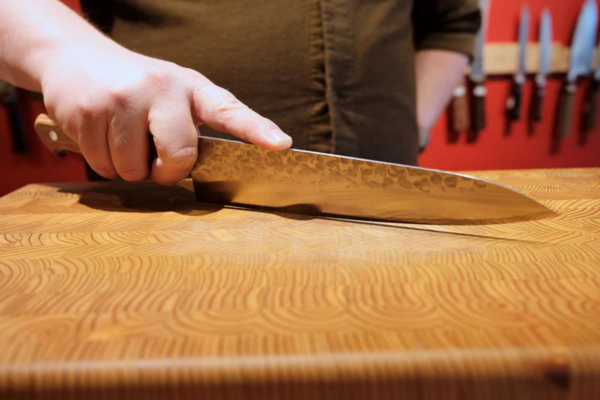
Japanese culinary tradition places tremendous emphasis on knife mastery, and nowhere is that more visually evident than at a Hibachi Japanese table.
Hibachi Japanese chefs work primarily with two types of blades:
- Santoku knife: A versatile all-purpose blade ideal for slicing proteins and vegetables with clean, efficient strokes.
- Gyuto (chef’s knife): A longer, thinner blade used for precision cuts on premium proteins such as filet mignon, lobster, and steak.
Beyond basic cutting, hibachi chefs perform high-speed precision work designed to entertain as much as to cook, rapid mincing of garlic and ginger, theatrical vegetable slicing, and the famous egg crack-and-scramble maneuver that remains a signature of the Hibachi Japanese experience.
At Kobé Japanese Steakhouse, chefs undergo extensive knife training to maintain both food quality standards and the visual performance that guests expect.
If you’re curious about the craftsmanship behind these tools, explore:
A Guide to the Types of Japanese Knives and Essential Knife Skills
Mastering the Flame: The Onion Volcano and Beyond
Few moments in dining are as universally recognized, or as thrilling, as the onion volcano. What appears to be spontaneous fire is actually the result of precise chemistry and heat management.
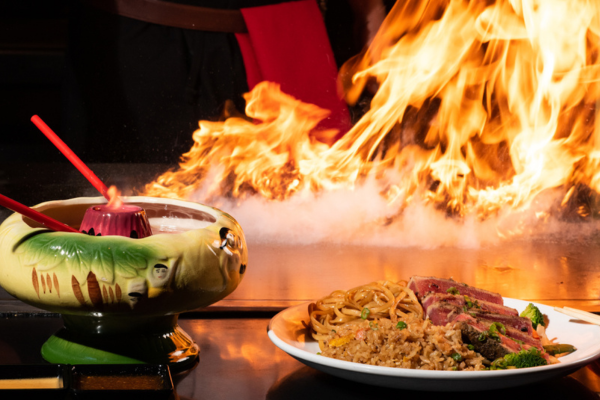
The hibachi onion volcano works by stacking sliced onion rings into a cone shape on the hot griddle surface, then pouring cooking oil into the hollow center. The oil, combined with the griddle’s residual heat and a controlled flame application, produces the signature eruption of fire.
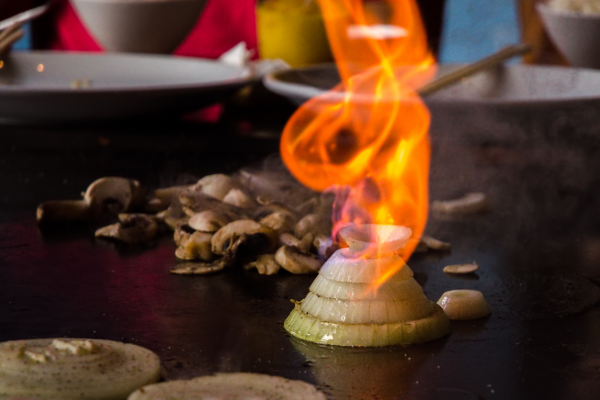
Chefs control three variables simultaneously:
- Oil quantity: Too little produces a small flame; too much creates an unsafe burn.
- Griddle temperature: The surface must be at sufficient heat to sustain combustion without the flame spreading.
- Timing: The flame is applied at the exact moment the oil begins to vaporize, creating the most dramatic visual effect.
Beyond the volcano, Hibachi Japanese chefs use flame deliberately throughout the meal, flash-searing proteins, caramelizing sauces, and creating dramatic presentations that transform the dining table into a stage.
The Performance Techniques: Shrimp Toss, Egg Roll, and More
The defining characteristic of Hibachi Japanese dining, the element that separates it from every other restaurant experience, is the integration of performance into cooking.
Key performance techniques include:
- The shrimp tail toss: Chef flips a cooked shrimp tail and catches it in a shirt pocket. Timing and spatial awareness are critical.
- The spinning spatula: Rapid rotation of the cooking spatula between serves, a display of coordination that builds guest energy.
- The egg roll: A raw egg is cracked on the griddle edge and rolled across the flat surface before being scrambled into fried rice.
- The food toss: Guests are invited to open their mouths and catch tossed food items, a participatory moment that breaks social barriers at communal tables.
These techniques are not improvised. They are rehearsed, refined, and maintained at professional standards. At Kobé Japanese Steakhouse, every chef masters these techniques as part of a structured training program, because the performance is as much a part of the product as the food itself.
See the technique for yourself and make a reservation today!
What Is Hibachi Japanese Food? The Menu Breakdown
Hibachi Japanese cuisine is built on a foundation of premium proteins, fresh vegetables, Japanese-inspired sauces, and signature rice preparations, all cooked fresh at your table.
Proteins: The Stars of the Hibachi Grill
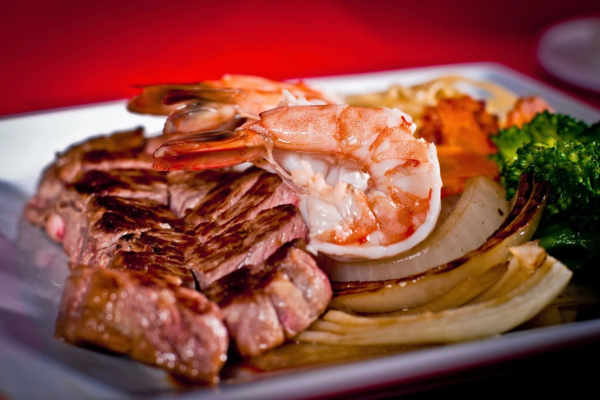
The centerpiece of any Hibachi Japanese meal is the protein selection. Common hibachi proteins include:
- Filet mignon: Seared at high heat to achieve a rich caramelized crust while maintaining a tender, pink interior.
- Chicken: Marinated and grilled with garlic butter and Kobé Japanese Steakhouse’s signature seasoning blend.
- Shrimp: Flash-cooked at high heat, with the classic tail-toss performance as part of the presentation.
- Lobster: A premium option that showcases the chef’s precision knife work and butter-searing technique.
- Salmon: Grilled with care to achieve crisp skin and a moist, flaky center.
- Scallops: Seared quickly at maximum heat to achieve caramelization without overcooking.
- Tofu: A plant-based protein option seared directly on the teppan, developing a golden, crisp exterior.
- Tuna: Premium sushi-grade tuna seared at high heat for just seconds per side, achieving a caramelized crust.
- Ribeye: A boldly marbled cut that thrives on the high heat of the teppan, rendering its natural fat into a rich, juicy sear.
- Sirloin: A leaner, firmer cut than the ribeye, the sirloin delivers clean, beefy flavor with a satisfying char.
- Wagyu beef: Its extraordinary marbling produces a buttery richness and tenderness no other cut can match.
Combination plates, such as steak and shrimp, or chicken and lobster, are among the most popular orders, allowing guests to experience multiple proteins in a single sitting.
Signature Sauces: The Flavor Architecture
Hibachi Japanese cooking relies on a trio of signature dipping sauces that define the flavor profile of the meal:
- Ginger sauce: A light, vinegar-forward sauce with fresh ginger and soy. Used primarily as a salad dressing and a dipping sauce for lighter proteins.
- Yum Yum sauce (white sauce): A creamy, slightly tangy mayo-based sauce with subtle paprika and garlic notes. The most universally beloved sauce in Hibachi Japanese dining.
- Teriyaki glaze: A sweet, umami-rich reduction applied to proteins during the final sear stage.
At Kobé Japanese Steakhouse, our signature sauces are house-made to proprietary specifications, one of the most frequently cited reasons guests return. Try them today!
Hibachi Fried Rice: More Than a Side
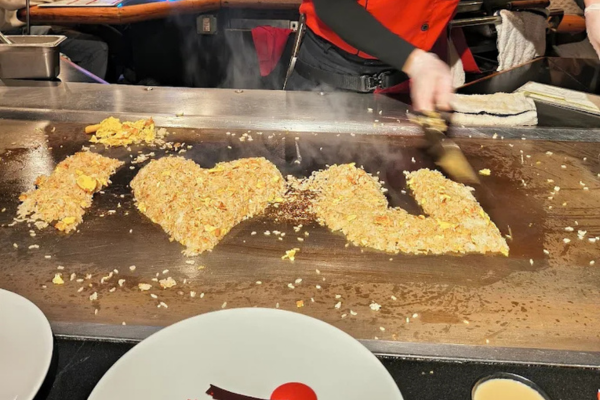
Hibachi fried rice is not an afterthought. Prepared directly on the teppan alongside the main proteins, it absorbs caramelized oils, soy, garlic, and fond from the cooking surface, developing a depth of flavor that is difficult to replicate at home.
The preparation sequence matters: rice is added to the griddle after the proteins have been cooking, positioned to absorb the rendered fats. Eggs, green onions, soy sauce, and butter are incorporated in stages, with constant tossing and folding to achieve consistent seasoning without over-browning.
For guests with dietary considerations, white rice or noodles can be substituted at most Hibachi Japanese restaurants.
Soup and Salad: The Ritual Opening
A traditional Hibachi Japanese meal begins with miso soup and a house salad before the teppan performance starts. The soup, a clear broth with fried onion strands, mushrooms, and green onions, is a palate-warming ritual that prepares guests for the richer flavors ahead.
Sound yummy? You don’t have to go in person, order online today!
What to Expect at a Hibachi Japanese Restaurant
If you’re visiting a Hibachi Japanese steakhouse for the first time, knowing what to expect will help you fully enjoy the experience from the moment you arrive.
The Communal Table Experience
Unlike standard restaurant seating, Hibachi Japanese dining centers on a large communal grill table that seats multiple parties together. This shared-table format is fundamental to the experience; the energy of the group amplifies the chef’s performance, and interactions between tables create a social atmosphere rarely found in fine dining.
For private groups celebrating birthdays, anniversaries, or corporate events, private sections can often be arranged to maintain exclusivity while preserving the live-cooking format.
Arrival and Seating
Because Hibachi Japanese restaurants operate in timed seatings, the chef begins cooking for the entire table simultaneously, and reservations are strongly recommended. Walk-ins are accommodated based on availability, but peak evenings (Fridays, Saturdays, and special occasions) fill well in advance.
Upon arrival, guests are greeted and escorted to their grill table. Communal seating means you may share a table with other parties, which most guests find to be part of the charm.
The Meal Progression
A full Hibachi Japanese dining experience follows a structured sequence:
- Soup and salad are served at the table while the chef prepares.
- Chef introduces themselves and begins setting up the teppan.
- Vegetables are sautéed, and performance elements begin (onion volcano, etc.).
- Fried rice is prepared on the griddle with fresh eggs and seasoning.
- Proteins are cooked to order and plated directly in front of each guest.
- Dessert service follows. Special celebrations (birthdays, anniversaries) are recognized.
The full dining experience typically runs 60–90 minutes, depending on group size and table composition.
Special Occasions and Group Dining
Hibachi Japanese restaurants are among the most popular venues for milestone celebrations, and for good reason. The combination of festive atmosphere, live performance, and communal seating creates a built-in event quality that standard restaurants cannot replicate.
At Kobé Japanese Steakhouse, we regularly host:
- Birthday dinners (with special recognition from your chef)
- Anniversary and date night reservations
- Corporate team dinners and client entertainment
- Family reunions and group celebrations
- Tourist and visitor dining experiences
For large groups, we recommend contacting your nearest Kobé Japanese Steakhouse location directly to arrange accommodations. Make a reservation today!
Why Hibachi Japanese Dining Continues to Grow in Popularity
In an era where restaurant traffic is increasingly competitive, and consumer expectations are higher than ever, Hibachi Japanese dining continues to grow, not just sustain. Here’s why.
The Experience Economy: Dining as Entertainment
Modern diners, particularly Millennials and Gen Z, consistently prioritize experiences over transactions. A meal at a Hibachi Japanese restaurant is inherently Instagrammable, inherently social, and inherently memorable in a way that standard table-service dining is not.
The live performance element creates organic content-sharing moments: the onion volcano, the shrimp toss, the flames. These moments travel on social media, driving awareness among people who have never visited the restaurant.
The Communal Format in a Disconnected Era
There’s something deeply human about gathering around a shared fire. The communal table format of Hibachi Japanese dining creates connection among strangers; parties who arrived separately find themselves laughing together, reacting to the same performance, and sharing the same energy.
In an age of increasing social isolation, that kind of in-person communal experience has become genuinely rare and genuinely valuable.
Multi-Generational Appeal
Few dining formats appeal equally to a five-year-old, a forty-five-year-old, and an eighty-year-old. Hibachi Japanese dining does.
The spectacle engages children while the food quality satisfies adults. The celebratory atmosphere suits any age group. This multi-generational appeal makes it the default choice for family celebrations at scale.
Consistent Quality at Premium Price Points
Hibachi Japanese steakhouses occupy a sweet spot in the market: elevated enough to feel special, accessible enough to visit regularly. For guests who want premium proteins, fresh preparation, and an experience that justifies the spend, the value equation is compelling.
At Kobé Japanese Steakhouse, this value equation has been refined across more than a decade of operations and multiple Florida locations, producing a dining experience that consistently earns five-star reviews and repeat visits.
See our quality for yourself, make a reservation today!
Hibachi Japanese Near Me: Finding the Best Experience in Florida
If you’re searching for the best Hibachi Japanese dining in Florida, the Kobé Japanese Steakhouse family of restaurants offers the most comprehensive coverage in the state, with locations spanning the Orlando metro area, Tampa, St. Petersburg, and beyond.
There are Hibachi Japanese restaurants across Florida. Here’s what separates Kobé Japanese Steakhouse:
- Voted #1 Japanese Restaurant in the region by guests and local publications
- Consistent chef training program ensuring performance quality across all locations
- Premium protein sourcing with fresh, high-quality ingredients at every table
- Kobé Japanese Steakhouse’s Rewards program offers birthday rewards and exclusive member benefits
- Catering services for events, corporate dining, and off-site celebrations
- Convenient online reservations and online ordering for select items
Reserve your table at Kobé Japanese Steakhouse, and experience why Hibachi Japanese dining at its best is worth every minute.
Frequently Asked Questions About Hibachi Japanese
What does hibachi mean in Japanese?
Hibachi (火鉢) translates directly to “fire bowl” in Japanese. The term originally referred to a small, portable charcoal heating device used in Japanese homes. Over time, particularly in the United States, it became associated with the performance-cooking restaurant experience we know today.
Is hibachi Japanese or Chinese?
Hibachi is Japanese in origin. The cooking style, the culinary techniques, and the restaurant tradition all trace back to Japan. The modern hibachi restaurant format, with teppanyaki-style cooking performed tableside, was introduced to the United States by Japanese chefs and restaurateurs in the mid-20th century.
What is the difference between hibachi and teppanyaki?
Traditional hibachi uses a small open charcoal grill. Teppanyaki uses a large, flat iron griddle. In modern American restaurants, the term “hibachi” is broadly used to describe the teppanyaki-style performance cooking experience. The terms are effectively interchangeable in American dining culture, though technically distinct.
What food is typically served at a Hibachi Japanese restaurant?
A Hibachi Japanese meal typically includes soup, salad, hibachi vegetables, fried rice, and a choice of protein, most commonly filet mignon, chicken, shrimp, lobster, scallops, or salmon. Meals are accompanied by signature dipping sauces, including ginger sauce and yum yum (white) sauce.
Do I need a reservation at a Hibachi Japanese restaurant?
Reservations are strongly recommended, especially on weekends and during holiday periods. Because hibachi cooking is done for entire tables simultaneously, timing and seating coordination are critical. At Kobé Japanese Steakhouse, reservations can be made online through our website or by calling your nearest location.
Is Hibachi Japanese dining appropriate for children?
Absolutely. Hibachi Japanese dining is one of the most family-friendly fine dining experiences available. Children are universally captivated by the live cooking performance, and the menu offers kid-friendly proteins and simple flavors alongside the full adult menu. Many families make Kobé Japanese Steakhouse their go-to destination for family celebrations precisely because of its multi-generational appeal.
Can I host a private event at a Hibachi Japanese restaurant?
Yes. At Kobé Japanese Steakhouse, we accommodate private group dining, corporate events, birthday parties, and special celebrations. Contact your nearest location to discuss group reservations and private event accommodations.
What if I don’t like Hibachi?
If you do not enjoy eating hibachi or do not have time to sit for the experience, no worries! At Kobé Japanese Steakhouse, we have a dining room and bar for a traditional dining experience. We also offer additional menu items, including sushi, bowls, and bento boxes.
Experience Hibachi Japanese Dining at Kobé Japanese Steakhouse
You now understand what Hibachi Japanese dining truly is: a culinary tradition rooted in centuries of Japanese craftsmanship, evolved through 20th-century innovation, and delivered in the United States as the most immersive restaurant experience available.
Great food satisfies hunger. Unforgettable experiences, the kind that become stories you retell, require something more.
At Kobé Japanese Steakhouse, we’ve been creating those experiences for guests across Florida for years. Every table brings together premium ingredients, highly trained chefs, and the kind of live performance that turns dinner into a memory.
Reserve your table today and discover firsthand why Hibachi Japanese dining continues to captivate guests across generations.